The Faerie Queene
By
Edmund Spenser
Transcription, correction, editorial commentary, and markup by Students and Staff of the University of
Virginia,
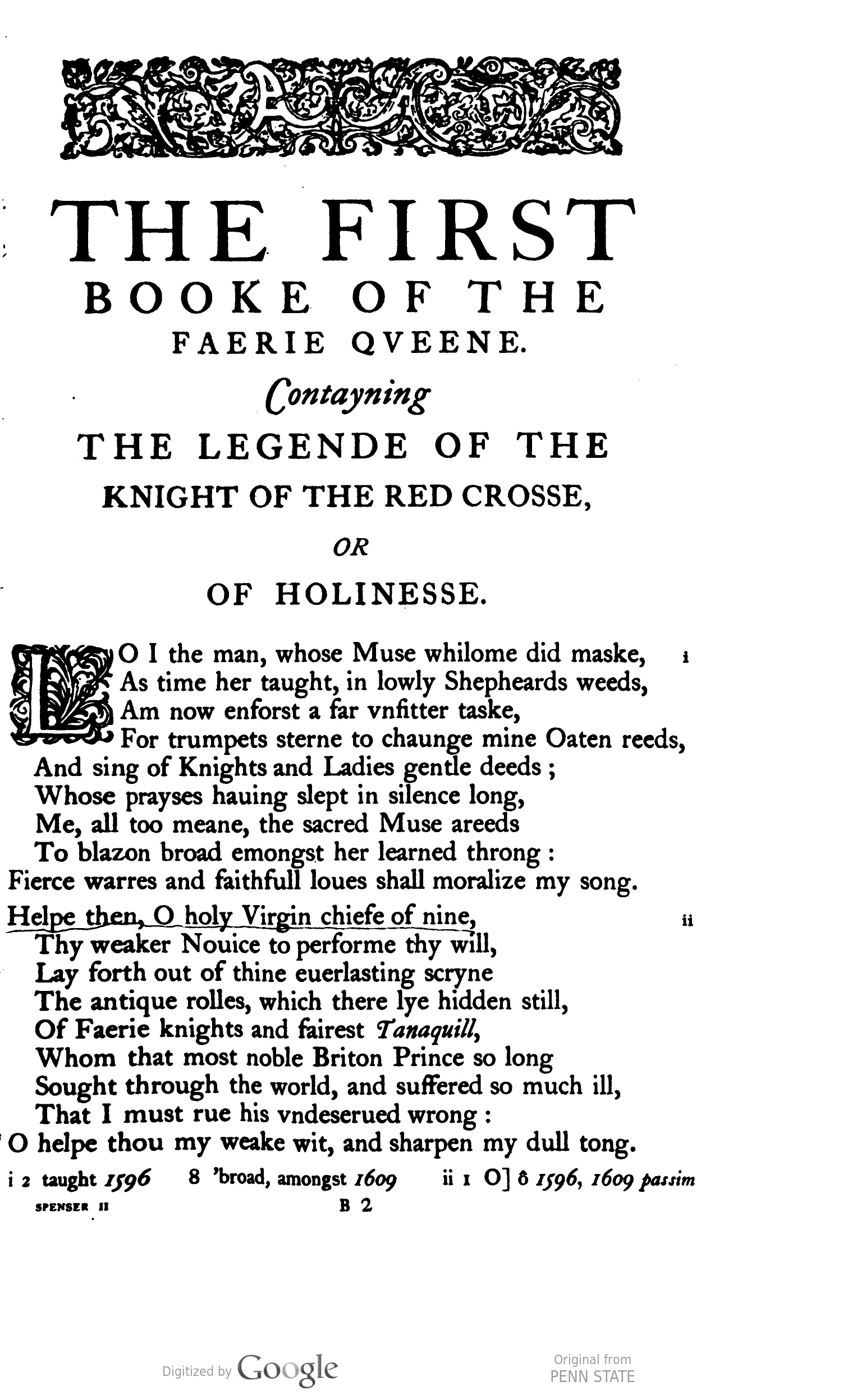
whilomeat one time, in the pastTanaquillTanaquill was a legendary Etruscan prophet whose forward-thinking was said to have led to her husband's decision to move to Rome,
where he eventually became Tarquin, the fifth king of Rome.
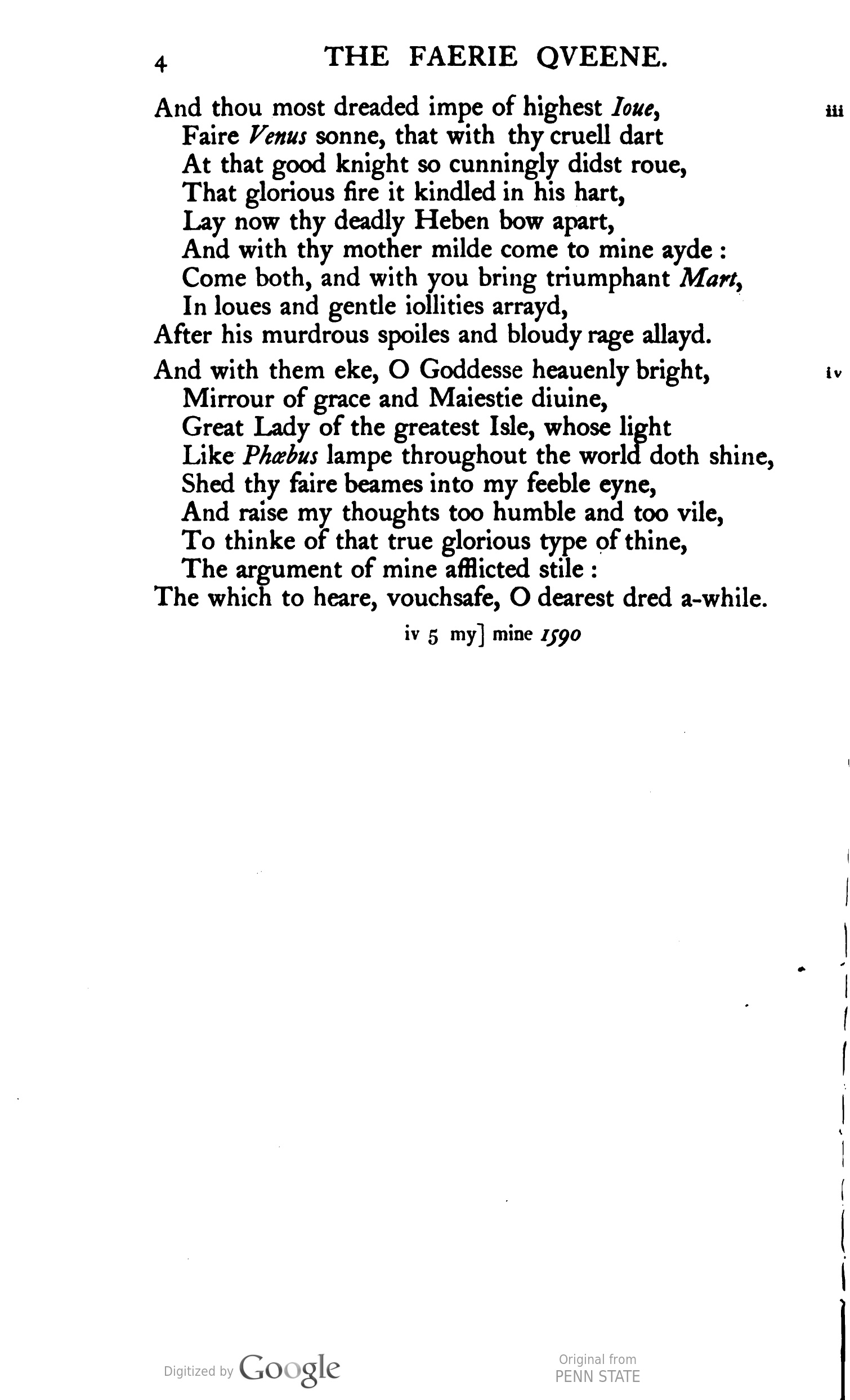
She is the first of many types for Gloriana, the titular Faerie queen. [RR]tongtongueIoveJove, or Jupiter, the chief Roman god. Also known as Zeus in
Greek mythology.HebenThe ebony bow
that belongs to Cupid, who has been described in the previous lines as the "cruell" son of Venus. [RR]MartA variant spelling for the god Mars, the Roman god of war. [RR]Mirrour"Mirrour" had a metaphorical meaning as a paragon or pattern of virtue; as mirror of grace, she is an earthly reflection of divine grace, as well as an exemplary model of the virtue for the world. [RR]PhoebusPhoebus Apollo is the god of the sun, so his "lampe" would be the sun itself. [RR]eyneeyes [RR]typeThe poet cannot think on her directly; he must think of her "true glorious type." "Type" is that by which she is figured, symbolized, and signified in the poem. Among several other "shadows," one of Elizabeth's main types is Gloriana, "greatest Glorious Queene of Faery lond" (I.i.3). In the Letter to Raleigh, Spenser writes: "In that Faery Queene I mean glory in my generall intention, but in my particular I conceive the most excellent and glorious person of our soveraine the Queene, and her kingdome in Faery land" (LR lines 32-4).
In theological history, "type" was often used to describe the figures of the "Old Testament" that prefigured people and events in the New Testament (their antitypes). [RR]afflicted
"Afflicted" carries a sense from the latin afflictus, to cast down; the stile is a pen. Together, Hamilton glosses the phrase as "humble pen." [RR]
vouchsafe
To bestow graciously or condescendingly. Here, the poet asks for his dedicatee to "hear" him awhile; to bestow her attention on the poem to follow. [RR]
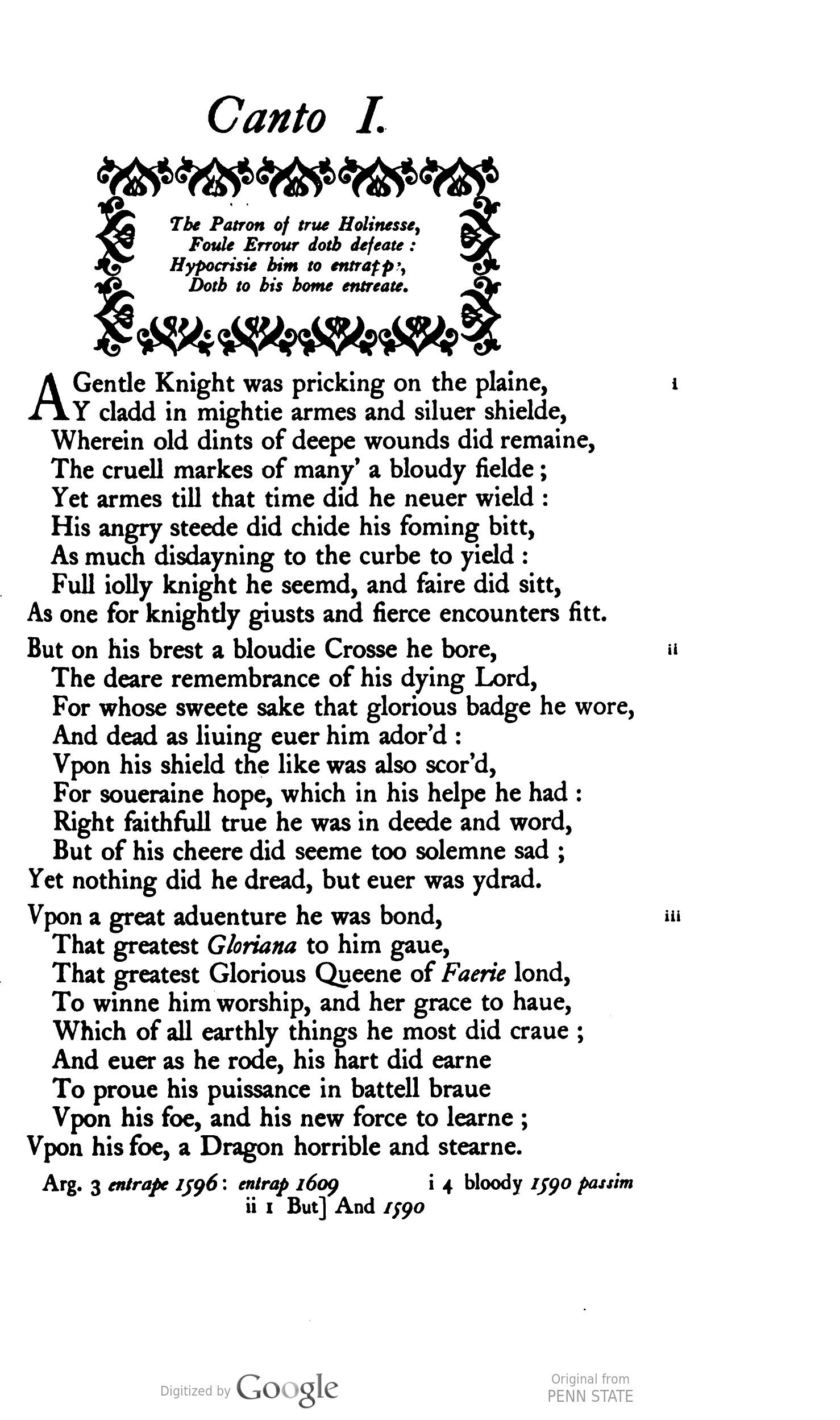
dredThe poet addresses Elizabeth directly as "O dearest dred. [RR]"YcladdClad; wearing. [RR]chide
The horse angrily chews on his bit, or mouthpiece, the device by which the rider controls his horse. [RR]
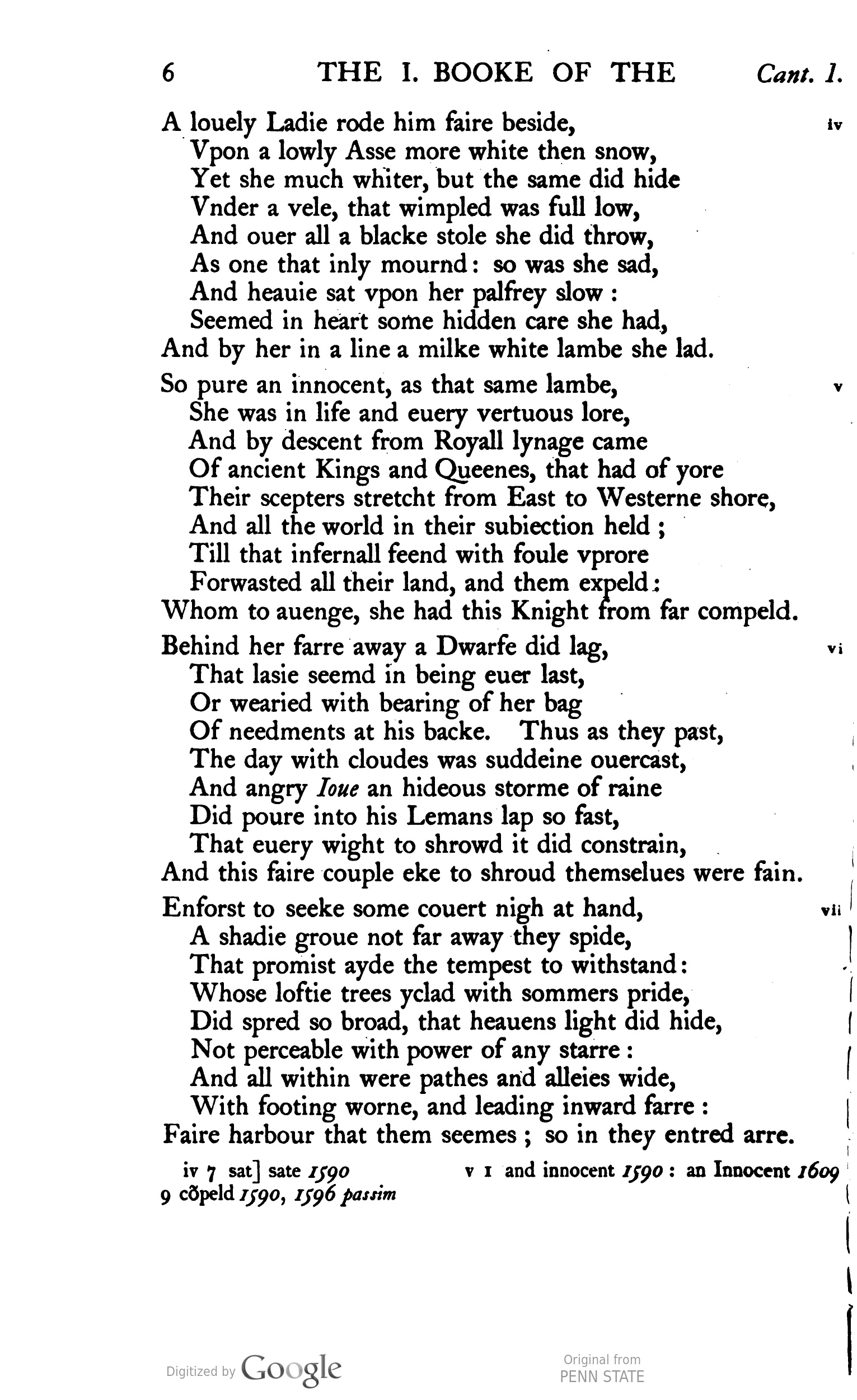
guistsJousts. [RR]scordScored, meaning decorated or carved. [RR]ydradDreaded. [RR]puissancePower, might (from French.) [RR]>wimpledFalling in folds. (Oxford English Dictionary)palfreyA horse for ordinary riding, often used to refer to a
small saddle horse for women. (Oxford English Dictionary)ForwastedLaid waste to; destroyed.needmentsThe things that Una needs; Spense coined this word. [RR]LemansHis beloved's lap. [RR]wightFrom Old English, a human being (man or woman). [RR]constrainTo exert or strain oneself (now obsolete). (Oxford English Dictionary)fainObliged or glad. [RR}perceablePiercable; that is, the tree
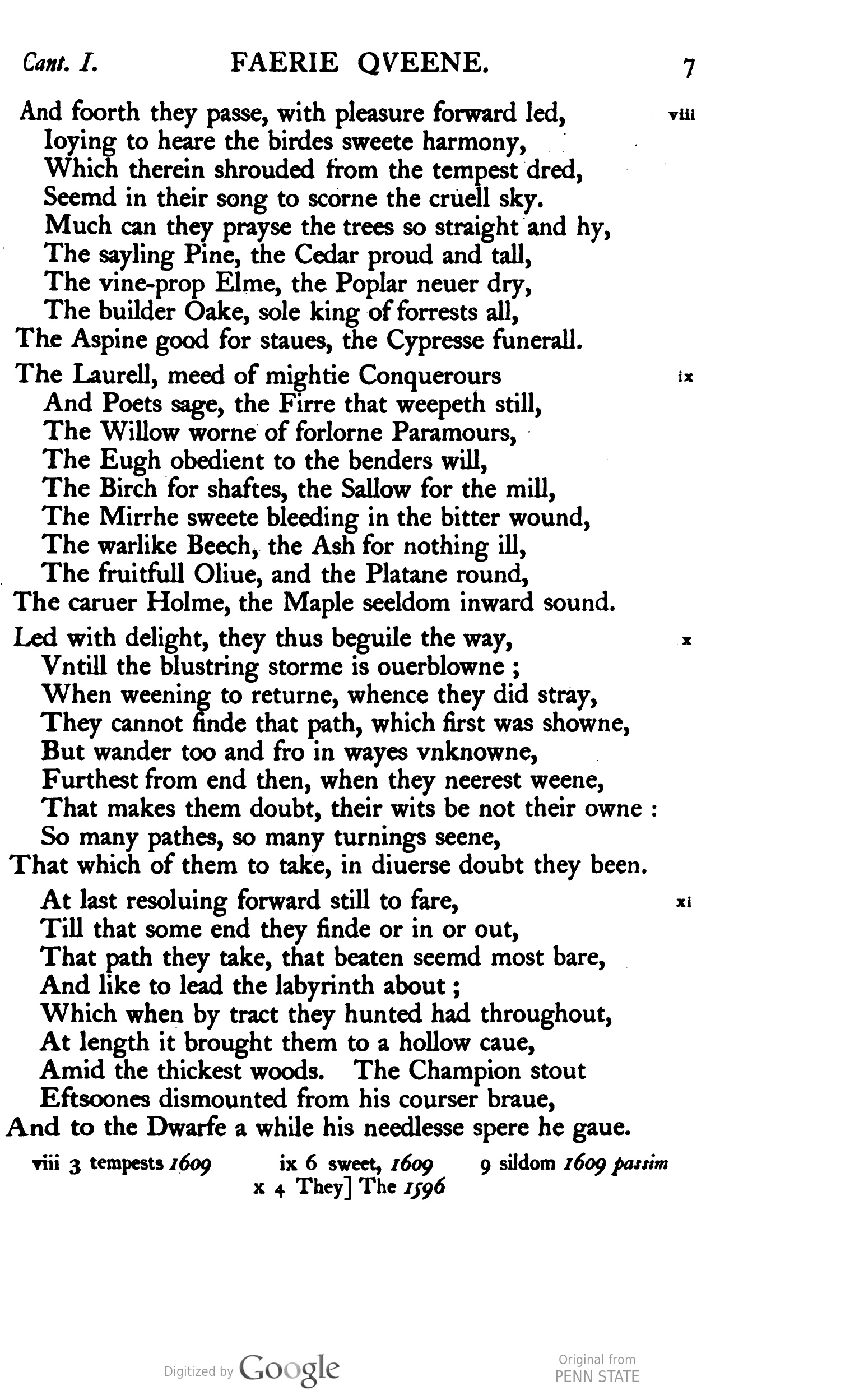
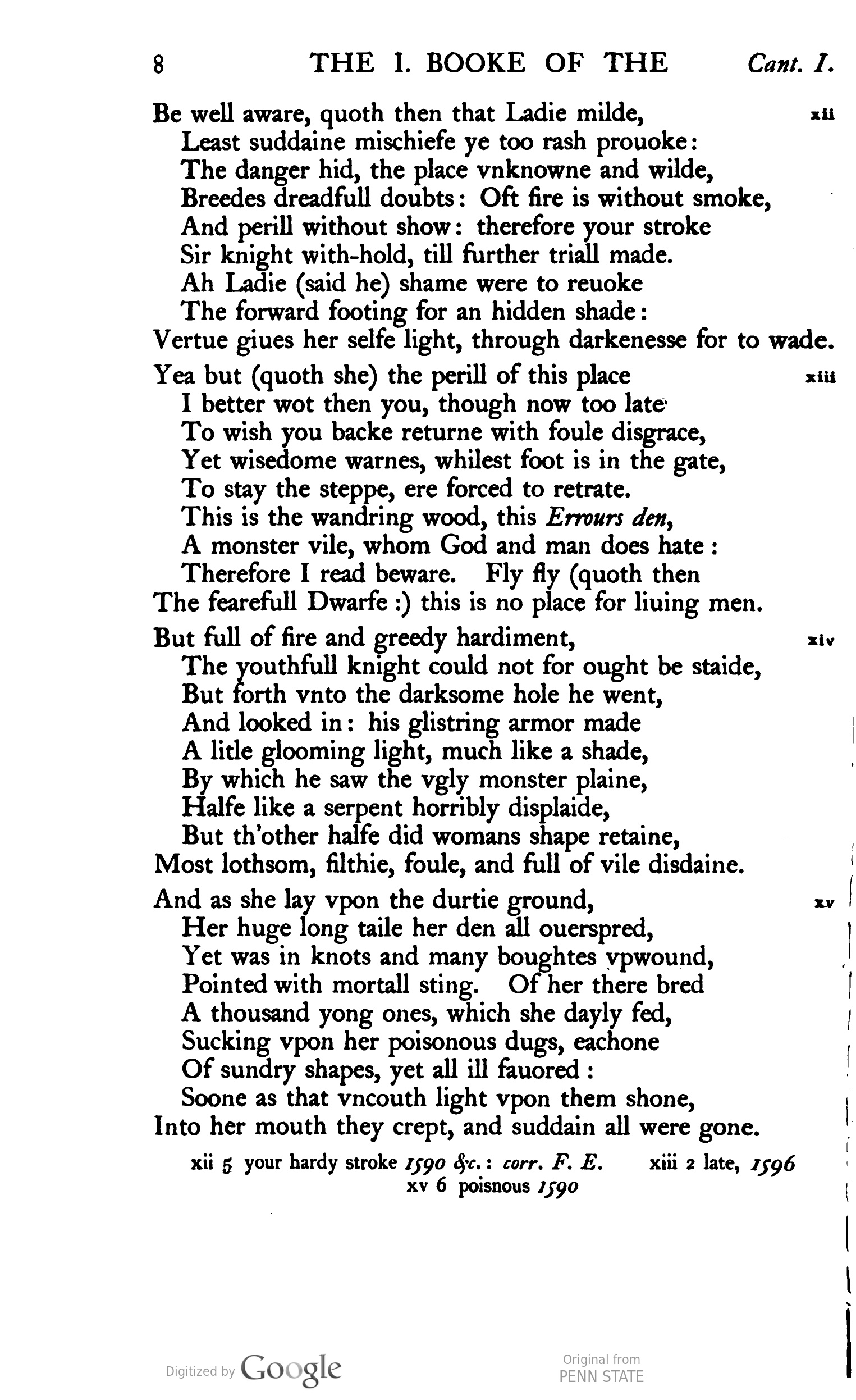
canopy is so thick that no light can pierce it. [RR]ElmeThe elm supports or props up the Vine. [RR]EughVariant spelling of the "ewe" tree. [RR]SallowA plant of the genus Salix, a willow. (Oxford English Dictionary)MirrheA variant of myrrh, which is a gum resin exuded by various Arabian and African trees that was formerly important as a sweet-smelling ingredient of incense or as a bitter-tasting medicinal herb (Oxford English Dictionary).PlataneA plane tree. [RR]HolmeEither a holly or a holme-oak. (Hamilton) [RR]weeningTo expect, hope, or intend (Oxford English Dictionary)strayFrom where they had strayed. [RR]fareTo travel. [RR]ChampionRedcrosse. [RR]EftsoonsSoon after. [RR]courserA powerful horse; a charger. [RR]quothUna speaks the next six lines. [RR]fireSpenser weaves aphorism or proverb into his verse, sometimes as a mark of a character's wisdom, as is the case with Una here, and sometimes, if the folk wisdom is distorted in some way, to show a character's deceit (for example, in stanza 33, Archimago gives advice to Redcrosse that borders on tautology: "the way to win / Is wisely to aduise"). [RR]LadieRedcross begins speaking.quoth_sheUna speaks the next eight lines. [RR]DwarfeThe dwarf begins speaking. [RR]staideKept from moving; halted. (Oxford English Dictionary)shadeHis armor makes a light so dim it is like a shadow. [RR]boughtesFolds or bends. (Oxford English Dictionary)bredErrour is surrounded by her offspring. [RR]dugsTeats or nipples. (Oxford English Dictionary)sundryVarious; distinct from one another. [RR]uncouththat is, the light from Redcrosse's shield. [RR]damTheir mother, Errour, starts up. [RR]effraideAlarmed (Hamilton). [RR]entraileWithout coils--now, her tail is stretched out to its full length. [RR]mayleShe sees Redcross in his "mayle" (a variant of the
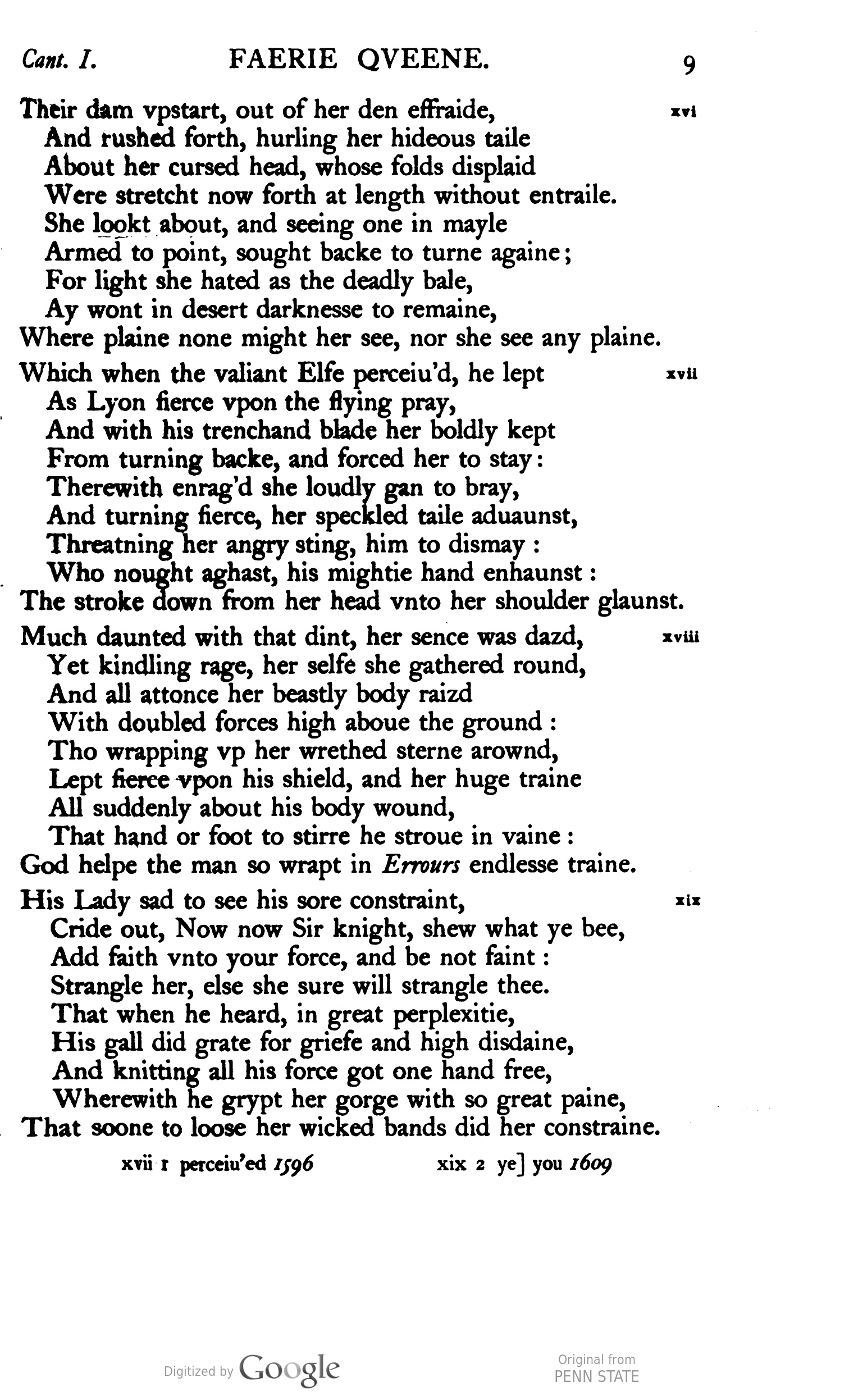
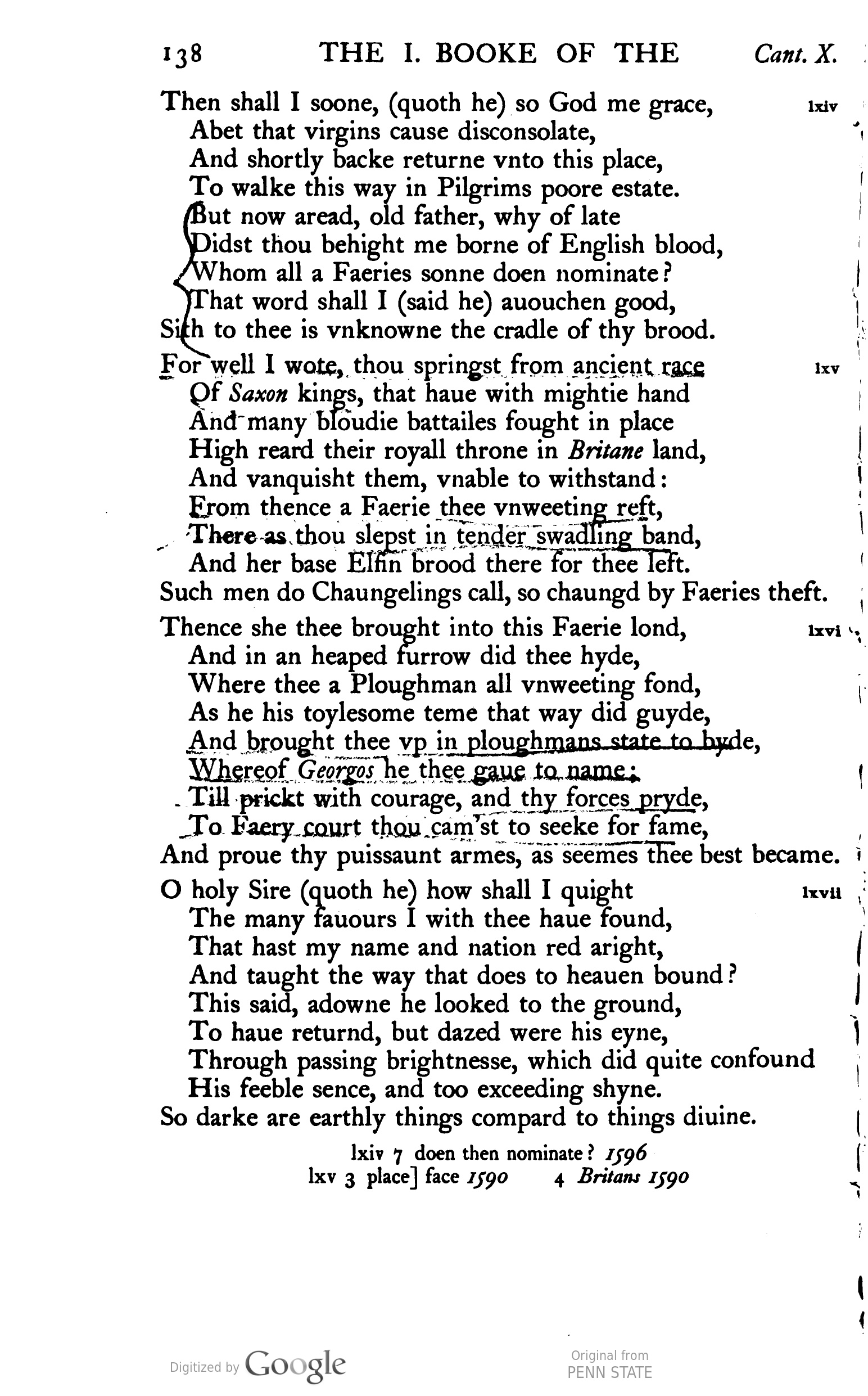
word "mail"), or armor, and tries to retreat back to her den. [RR]baleInjury or torment. (Oxford English Dictionary)wontShe is "ever accustomed" to remain in darkness (Hamilton). [RR]valiant"Valiant elfe" refers to Redcrosse. The poem distinguishes between knights in Faery land (the elves or fairies) and Briton knights (such as Arthur, who arrives in canto vii of Book I). In canto x, the character Contemplation reveals that Redcrosse is actually descended from "Saxon kings" (x 64) — he is a changeling raised in Faery land, not an Elfe. [RR]trenchandSharp. [RR]dismayDefeat. [RR]aghastRedcross is unfazed. [RR]enhaustRaised up (Hamilton) [RR]dintA blow. [RR]attonceAt once. [RR]LadyUna, watching from the side. [RR]perplexitieLiterally, Redcrosse is entangled; psychologically and oralliy, he is distressed and confused. [RR]gallSource of jealousy or anger. [RR]gorgeErrour's throat. [RR]slackeForced him to loosen. [RR]parbreakeVomit. [RR]NilusThe Nile River. [RR]valeSimilar to valley, especially one that is wide and flat. [OED]outwellPour forth (Hamilton).auvaleBegins to abate. [RR}reedSee. [RR]same"The same"
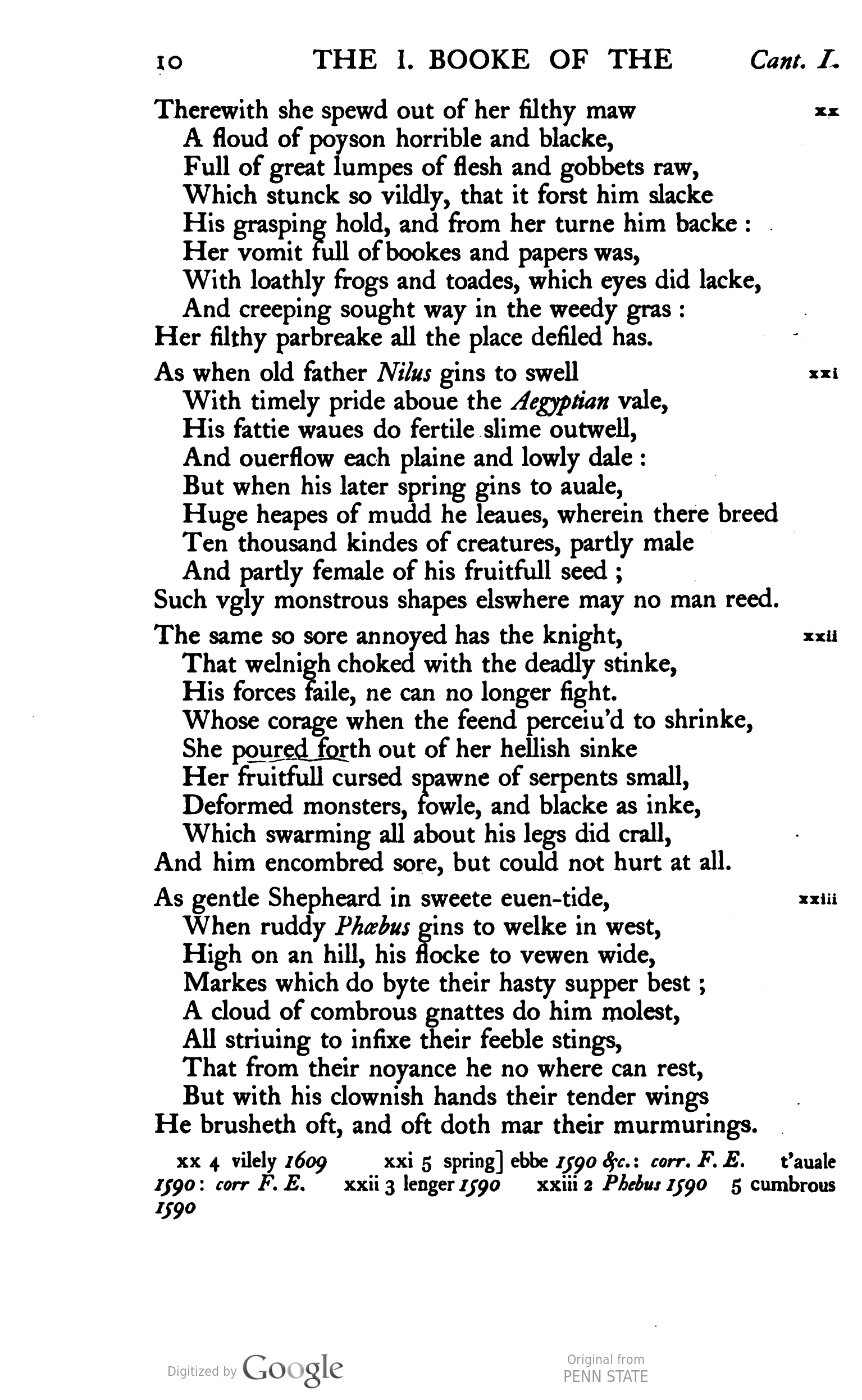
relates the simile back to Redcrosse's experience: "as when.... the same." [RR]welnighAlmost.[RR]feendErrour sees Redcrosse's courage shrink. [RR]sinkeHer womb or organs of extretion. (Hamilton)encombredAnnoyed or harassed. [RR]ShepheardThe stanza that follows ia another epic simile; here
Redcrosse is compared to a shepherd protecting his flock. [RR]euenEvening. [RR]welkeTo wane or set. [RR]Markes
The shepherd watches his flock as they eat their supper. [RR]
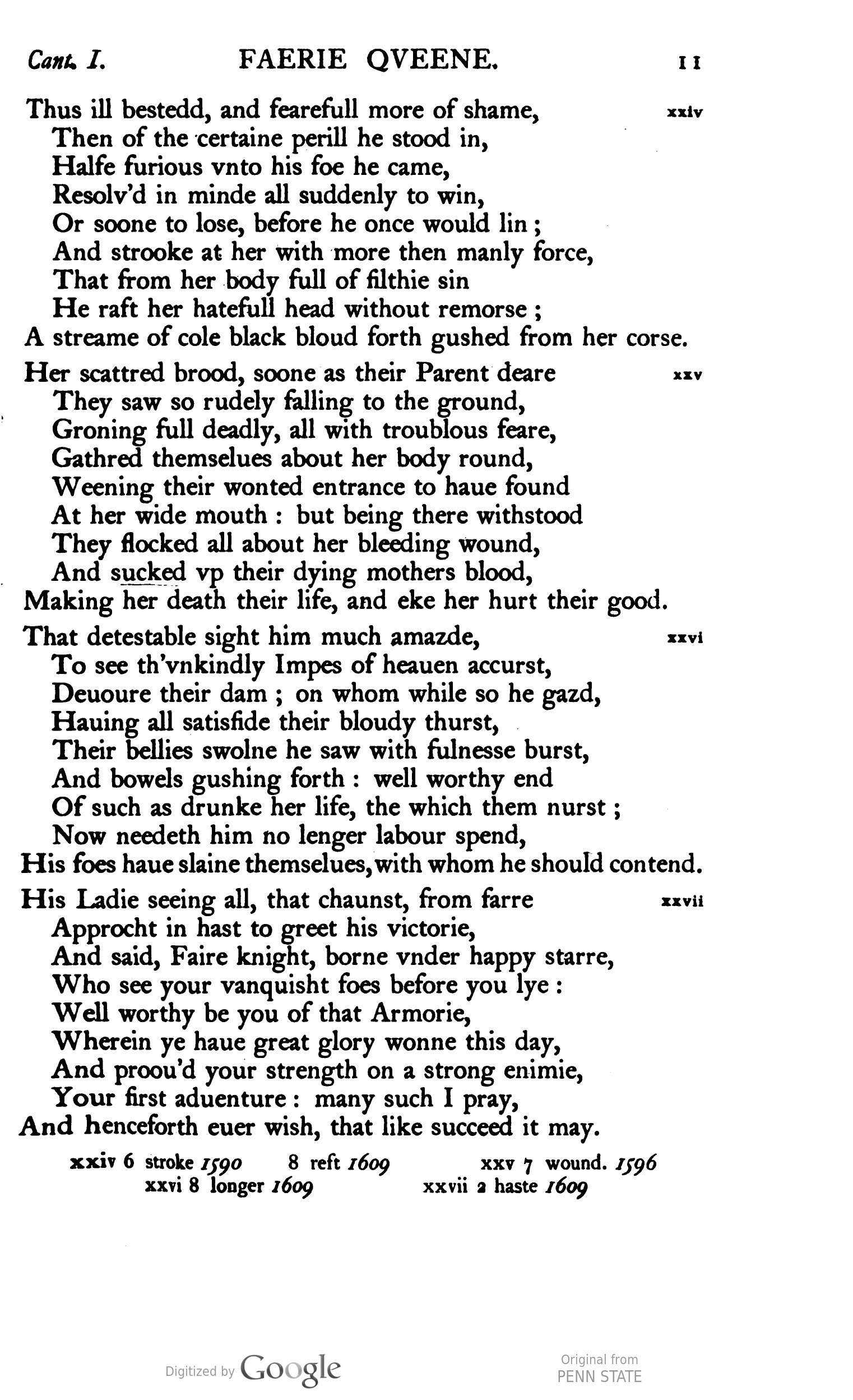
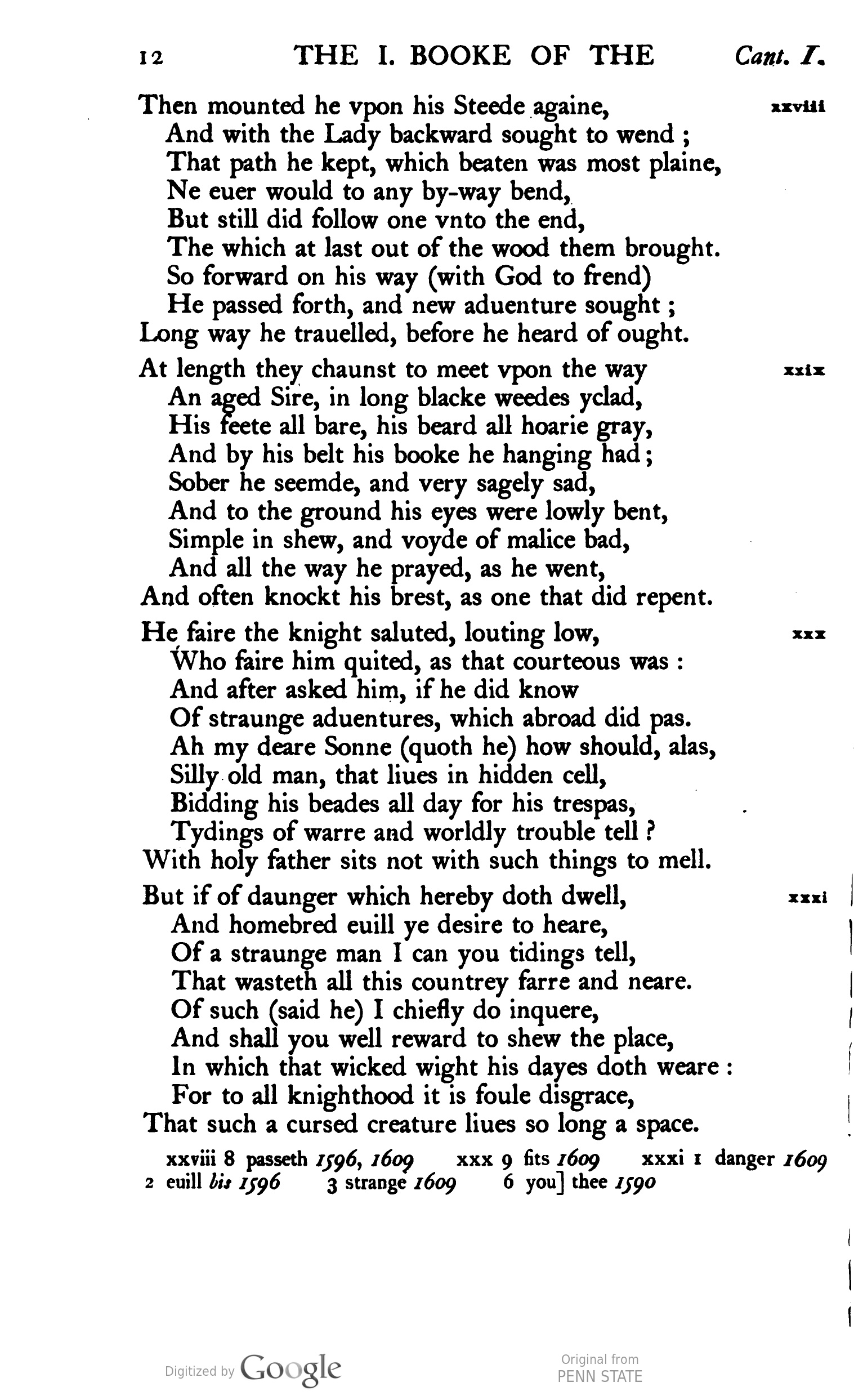
noyanceAnnoyance; harassement. [RR]clownishRough, belonging to a rustic. (Hamilton)besteddIn a bad situation. [RR]Halfe"Halfe furious" prefigures when Redcrosse later gives in to full fury (ii. 5). Spenser uses this construction often: for example, Redcrosse is soon "half enraged" (i.50) by false Una's "halfe blushing" (i.49), then "halfe amazed" (vi.1) after his lucky escape from the House of Pride. Trevisan, fleeing from Despaire, runs "halfe dead with dying feare" (ix.30). Una, in her oneness and wholeness, is never half-anything.linCease, leave off (Hamilton).WeeningHoping to find their usual entrance. [RR]worthyThe poem tells us this is a worthy end for these cursed offspring who drank the life (i.e., the blood) of the mother who had nursed them. [RR]chaunstAll that happened. [RR]ArmourieUna tells Redcrosse that he is worthy of the armor he wears. This is significant given that when we first meet the knight, we learn that he has put on this venerable armor for the first time ("armes till that time did he never wield" [i.1]) and he is seeking to "prove his puissance" (i.3). [RR]with_GodWith God as a friend.loutingBowing humbly (Hamilton).quitedReturned the salutation (Hamilton).
SPENSER’S
FAERIE QUEENE
EDITED BY
J. C. SMITH
VOLUME I: BOOKS I-III
OXFORD
AT THE CLARENDON PRESS
MCMIX
FAERIE QUEENE
EDITED BY
J. C. SMITH
VOLUME I: BOOKS I-III
OXFORD
AT THE CLARENDON PRESS
MCMIX
 Page
Page